
When adults ask, “What is a tongue tie?” they are rarely asking out of curiosity. They are asking because their body has been quietly signaling for years that something feels off. Jaw tension never fully releases. Sleep doesn’t feel restorative. Speaking for long periods feels effortful. Anxiety shows up in the body before it ever reaches the mind.
For many adults, the realization that a tongue tie could be involved lands somewhere between relief and disbelief. Relief that there may finally be a reason for decades of symptoms—and disbelief that something present since birth could remain unnoticed for so long.
After more than 30 years as a speech-language pathologist specializing in oral motor myofunctional therapy and adult tethered oral tissues, I can say this with certainty: tongue tie does not disappear with age. It simply changes how it expresses itself.
This article answers what a tongue tie from an adult, whole-body perspective is—because anatomy alone never tells the full story.
What Is a Tongue Tie Beyond the Textbook Definition?
Most people expect the answer to what is a tongue tie to be a quick visual scan that swiftly identifies if a tie is present or not. But for adults, tongue tie is rarely visually apparent. It is a functional issue, not a cosmetic one.
A tongue tie, clinically known as ankyloglossia, restricts the tongue’s movement, elevation, stabilization, and rest. It occurs when the frenulum, the band of tissue under the tongue, is too short, thick, or restricted to support harmonious movements for speech and feeding tasks.
In adulthood, the issue is not whether the tongue can stick out past the lips. The real question is whether the tongue can elevate fully to the palate, move independently from the jaw, and maintain a relaxed resting posture without effort.
When the tongue cannot perform these basic tasks efficiently, the body finds another way. That is where compensation begins—and where symptoms slowly accumulate.
What is a Tongue Tie Doing Here in Adulthood?
You’ve actually had this tie since before you were born!
The tongue begins forming and is initially attached to the floor of the mouth during gestation, around weeks 4-8. In normal development, the tongue starts to detach from the bottom of the mouth in weeks 6-8. This is when the frenulum will form to support the tongue, and it will be thinning and shortening.
If this separation process is disrupted, the frenulum may remain too short, thick, or tight to properly support the tongue muscles, resulting in a tongue tie.
Tongue ties are present at birth and considered congenital; often, there is a genetic link, as oral ties run in families. Tongue ties are like snowflakes; no two are exactly alike, and they do not all impact the body in the same way.
Ties can be anterior or posterior, vary in length or thickness, and therefore come in different degrees of restriction and compensation.
To begin understanding your tongue tie, I created a self-check for home that you can complete to determine whether you have an adult tongue tie. You can grab the self – check for free here: The 1-2-3 Tongue Tie Self-Check
Why Adults Are Still Asking “What Is a Tongue Tie” Decades Later
Tongue tie often escapes diagnosis in adulthood because adults are exceptional compensators. From an early age, the body learns how to chew, speak, swallow, and breathe around restriction. These adaptations work—until the cost becomes too high.
Many adults arrive asking what is a tongue tie, only after years of unexplained discomfort. Jaw pain becomes a daily companion. Headaches appear without a clear trigger. Neck and shoulder tension feel permanent. Sleep quality declines even though sleep duration remains the same. Orthodontic work relapses despite compliance.
These adults were not asymptomatic. They were adaptive.
Likely, there was a time your parent inquired to a medical professional, pediatrician, or ENT about observing that white restrictive band under your tongue. Only to be met with reassurances that it bears no impact on speech or swallowing skills, so there is no need to address it.
Your childhood continued, and your compensations carried you through life.
What Is a Tongue Tie Doing to the Adult Airway Over Time?
The tongue plays a critical role in maintaining airway stability. At rest, it should sit gently against the palate, creating space for nasal breathing and supporting the airway during sleep.
When tongue mobility is restricted, the tongue struggles to maintain that position. Resting instead on the floor of the mouth.
Over time, the airway becomes less stable, and breathing patterns shift. Mouth breathing becomes more frequent. Snoring develops or worsens. Sleep becomes lighter and more fragmented.
Adults often report waking with a dry mouth, clenching their teeth at night, or feeling unrefreshed even after a full night’s sleep. Many never suspect that tongue tie could contribute to these experiences. Yet when they finally ask what is a tongue tie, the airway puzzle often begins to make sense.
One of the main goals of therapy is to achieve tongue resting on the palate. This resting placement allows the nasal passages and airway to open and settles the nervous system. When you reduce underlying anxiety, breathing patterns can stabilize, allowing the dimmer switch to be lowered on your baseline stress and anxiety.
Diaphragmatic breathing becomes another target in a therapy plan. Utilizing your full lung capacity to feed oxygen-rich air into your cells. Yes, breathing can be altered by your tongue placement and, therefore, improved by it as well.
What Is a Tongue Tie’s Relationship to Jaw Pain and TMJ Symptoms?
The jaw is not designed to stabilize swallowing or speech on its own. That role belongs to the tongue. When the tongue cannot anchor effectively against the palate, the jaw steps in to help.
Over time, this creates a pattern of overuse. The jaw tightens during swallowing. Chewing becomes uneven, with a preference for one side. Facial muscles remain activated even at rest, causing facial tension and tightness. What begins as subtle tension often progresses into chronic TMJ pain, clicking, popping, or limited opening.
Many adults are told their jaw pain is caused by stress, posture, or grinding alone. While these factors contribute, they often represent downstream effects rather than root causes. Understanding what is a tongue tie reframes TMJ not as an isolated joint issue, but as part of a larger functional pattern.
If you’re an adult who has limited benefit from traditional TMD treatments, then considering tongue tie as a possible factor could be the pathway to healing.
I’ve written several blog articles on TMJ/TMD that you may find helpful; check them out on the BLOG for a deeper dive into the connection.
Swallowing Changes Adults Rarely Notice—Until They Do
A mature swallow is quiet and efficient. The tongue elevates to the palate, the jaw remains relatively still, and the lips seal without strain.
In adults with tongue tie, swallowing often looks different. The tongue pushes forward instead of upward, sometimes poking between the teeth and lips. The lips tighten excessively to compensate for that tongue poking out, or they stay gapped open. The jaw braces with every swallow, jutting forward to accommodate the forward tongue and clenching to help elevate the posterior tongue.
Because adults can swallow up to a thousand times per day, these small inefficiencies accumulate into chronic muscle tension.
Adults asking what is a tongue tie frequently describe difficulty swallowing pills, a sensation of tightness in the throat, food feeling stuck, or digestive discomfort that never quite resolves. These experiences often improve once oral mechanics are addressed at their source.
Speech, Voice, and the Hidden Effort of Tongue Tie
Many adults don’t realize that tongue-tie can affect speech. In reality, adults often speak clearly but inefficiently. Usually, it may be imperceptible to the listener, but you are aware that something feels imprecise.
Restricted tongue movement can increase reliance on jaw motion for articulation. Breath support may compensate for reduced tongue precision. Over time, this leads to vocal fatigue, hoarseness, or a feeling that speaking requires more effort than it should.
Familiar sounds to feel subtle slips on are the S, L, R, SH and CH. These sounds require lateral bracing or elevation, which the tongue may not be able to reach or maintain consistently.
Professionals who use their voice extensively—teachers, therapists, speakers, singers—often feel the impact first. They may not sound impaired, but they feel it. That discomfort often prompts the question: what is a tongue tie, and why does my voice feel so tired?
Vocal fry, that raspy voice sound, may indeed be a side effect of a restricted tongue. The tongue is held tight and may pull the hyoid up and out of its natural resting place. The hyoid is a small bone at the top of that lump in the throat that moves up and down for speaking and swallowing.
If it’s pulled upward, it may drag the vocal cords into tension, causing vocal strain.
What Is a Tongue Tie’s Role in Posture and Whole-Body Tension?
The tongue does not function in isolation. Through fascial connections, it influences the neck, shoulders, diaphragm, and pelvic floor.
When tongue mobility is limited, the body adjusts posture to maintain balance and airway access. The head may shift forward. Shoulders elevate. Core stability changes. Pelvic floor tension may increase.
Adults frequently describe chronic tightness that feels global rather than localized. Massage provides temporary relief, but tension returns. Stretching helps briefly, but nothing “sticks.” When these adults finally explore what is a tongue tie, they often discover that oral restriction has been quietly shaping posture for decades.
Why Tongue Tie Is So Often Missed in Adults
Tongue tie is frequently missed because assessment focuses on appearance rather than function. A tongue that protrudes past the lips may appear unrestricted, even if it cannot elevate, stabilize, or coordinate effectively.
Adults also minimize symptoms because they have always lived with them. When tension feels normal, it stops raising red flags.
Asking what is a tongue tie requires shifting the lens from “Does it look normal?” to “Does it move efficiently?”
Medical professionals are not trained to identify these connections. Most will downplay the role of a restricted frenulum and steer you away from intervention. When searching for answers, we need specialists who understand these connections and how best to evaluate a tongue tie.
We like the Tongue Tie Life website for its state-by-state list of preferred providers. Those who specialize in the diagnosis and treatment of tongue ties. This can be a great place to start your search and save you the experience of being gaslit or placated out of a medical office.
What Is a Tongue Tie Evaluation for Adults?
A comprehensive adult evaluation looks at how the tongue works within the system as a whole. It examines movement quality, resting posture, swallowing patterns, breathing habits, and compensatory strategies in the lips, jaw, and neck.
Function reveals what appearance cannot. A complete symptoms checklist will be discussed to identify where your functional issues lie.
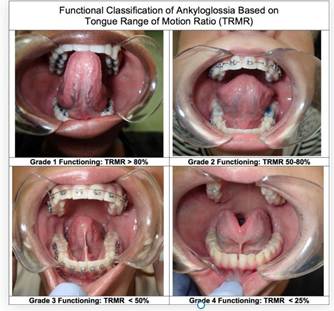
Tongue ties are often graded 1-4 for severity. This involves the appearance of the tongue and its range of motion. Dr. Richard Baxter provides an excellent visual illustration of how the tongue may appear in each of these grades.
Why Release Alone Rarely Solves the Problem
Many adults believe that understanding what is a tongue tie leads directly to surgical release. While release may restore range, it does not automatically restore coordination and function.
Without myofunctional therapy, the nervous system often defaults back to old patterns. The tongue may not learn how to elevate efficiently. Jaw dominance may persist. Symptoms may partially improve and then plateau.
Therapy teaches the tongue how to move, rest, and work in harmony with the rest of the body. For adults, this retraining is often the missing link.
Myofunctional therapy pre-surgery is often key to allowing for a complete release of the frenulum during the surgery. Post-surgery, myofunctional therapy helps retrain movements to where they were always intended to move in harmony.
The Emotional Weight of Finally Understanding
Adults frequently experience an emotional response when they truly understand what is a tongue tie. There is relief in knowing their symptoms had a cause. Also, there is grief for years spent compensating without answers. But then there is validation after being told for decades that nothing was wrong.
As tension patterns soften, many adults report reduced anxiety and greater bodily ease. The nervous system no longer has to work in constant protection mode.
A Whole-Person View of What Is a Tongue Tie
Tongue tie is not just an oral finding. It is a whole-body experience shaped over time for adults. Effective care often involves collaboration among speech-language pathologists, myofunctional therapists, dentists, medical providers, and bodyworkers who understand function, not just structure.
Healing happens when systems work together—just as the body always intended.
Final Thoughts: Asking the Right Question: What Is a Tongue Tie?
When adults ask what is a tongue tie, they are not looking for a label. They are looking for understanding.
Your body was never broken. It adapted intelligently to restrictions. Those adaptations kept you functioning—but they also carried a cost that, over time, became increasingly difficult to manage.
When tongue function improves, many adults experience more than symptom relief. They experience ease, clarity, and a sense that their body finally works with them rather than against them.
From tongue to toes, every system is tied together.
And when the tongue finds freedom, the rest of the body often follows.
Keep educating yourself as you start this journey. Utilize the RESOURCES on my page to help you navigate your questions.
Then check out my eBook, written for you as the adult, to better understand the larger impact of tethered oral tissues. Untangling the Ties: A Guide to Adult Tongue Tie and Tethered Oral Tissues.