
If you are researching signs of lip tie, chances are something feels persistently tight, strained, or unresolved.
Maybe your upper lip feels restricted when you smile.
Or perhaps you notice that your lips are parted at rest and you have to consciously bring them together.
Maybe your dentist mentioned your frenulum once, then moved on without explanation.
Many adults sense that something is contributing to their jaw tension, breathing pattern, chewing, or speech fatigue, but they cannot quite identify the root cause.
As a speech-language pathologist trained in oral-motor and myofunctional therapy, I have evaluated countless adults who have adapted around lip restriction for decades. The body is brilliant at compensating. It finds a way to make things work. But compensation does not mean efficiency. And it certainly does not mean freedom.
Let’s look closely at the true signs of lip tie in adults and why they deserve more attention than they typically receive.
What Is a Lip Tie and Why Does It Matter in Adulthood?
A lip tie occurs when the labial frenulum—the connective tissue attaching the inside of the lip to the gum is too thick, short, or webbed, limiting normal mobility. In adults, we most often evaluate the upper lip.
But signs of a lip tie can also occur on both the top and bottom lips. Let’s explore both placements.
A healthy upper lip should lift comfortably without pulling the gum tissue tightly. It should retract evenly on the left and right sides during smiling, create a natural seal at rest, and assist in forming speech sounds like “p,” “b,” and “m.” effortlessly.
When a restriction exists, the lip cannot move independently. Instead, surrounding muscles compensate. The lip may rest high above the tooth line, exposing teeth and gums when laughing, and feel strained or effortful when speaking.
The lower lip may feel tight if tied, but the tightness seems oriented lower on the chin. A furrowing of the chin may be present as the muscles work overtime to assist the lower lip in movement.
Over time, those compensations ripple outward. They influence jaw stability, airway posture, neck alignment, and even the nervous system.
Sadly, lip tie is often noticeable but often ignored as a factor in your mouth or body’s health. The decades-long medical advice has been to let it break on its own! No intervening, just acknowledgement that it is indeed there, and then the hope that you will smack your lip on something and break it open!
That is why the signs of lip tie rarely stay isolated to the mouth. From years of being ignored, and no facial injury suffered, you are left with the ripples of recruitment and compensation through the jaw, neck, back, and pelvic floor.
Early Signs That Often Go Unrecognized
Many adults with lip ties never received an evaluation as children. When I review histories with clients, they often describe patterns that suddenly make sense in hindsight.
For example, some adults recall chronic mouth-breathing from childhood. If the upper lip could not seal comfortably, the mouth often remained slightly open. That open posture shifts the tongue downward and destabilizes the airway early in development.
Others remember orthodontic treatment to close a gap between the front teeth. While orthodontics can improve alignment, it does not address the mechanical pull of a restrictive frenulum. If tension remains at the gum line, the underlying force continues to influence the tissue.
Many adults report needing a second or even third round of braces due to relapsing orthodontic work.
Some adults experienced early cavities along the gum line. When a frenulum pulls tightly on the gum tissue, it can create small pockets or tension zones that are harder to clean effectively. By adulthood, the gums have been drawn away from the tooth, causing gingivitis and gingival recession.
Interestingly, many adults recall banging their lip and having it bleed profusely; some do not recall this, yet their frenulum tells the story for them. The frenulum that has been busted is not fully free of the tie. They heal in odd patterns and continue to restrict proper muscle function.
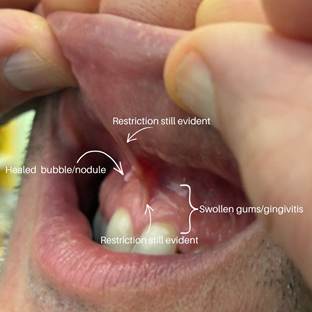
Here we see evidence of a ruptured lip frenulum, which has healed with a bubble protruding from the middle of the frenulum. The frenulum remains attached too tightly at both ends, with clear evidence of swollen gums/early gingivitis.
These early signs of lip tie often fade into the background of childhood memories, yet the structural pattern persists into adulthood.
Structural Signs of Lip Tie in Adults
When adults look for signs of lip tie, they often focus on appearance alone. But structure only tells part of the story. Function tells the rest.
In considering the appearance, we look at both the inside and outside of the lip.
If you gently lift your upper lip and notice that the tissue in the center turns white or blanches, that blanching suggests tension. Healthy tissue should lift smoothly without a significant color change. Blanching indicates that the frenulum is pulling tightly against the gum.
You may also notice that your lip does not lift evenly. Instead of flaring upward, it may feel anchored at the center, creating a pulling sensation toward the nose. Over time, this restriction limits natural lip mobility and influences how the surrounding facial muscles activate.
The presence of thicker tissue or wings/sails as the tissue fans out by the attachment point is another visual indicator of a restrictive lip tie.
Next, observe from the outside. Is the space from the nose to the lip short, and is it flat? Does the upper lip appear thin and almost invisible? These are visual characteristics of an upper lip tie.
When examining the lower lip, pull the lip away. Is it hard to move, and is the frenulum blanched white? Does the outside observation reveal a deep furrow in the chin, or a puckered walnut-shaped chin? Those are characteristics of a lower lip tie.
Some adults report that smiling feels tight or strained. They avoid wide smiles without consciously realizing why. The body often adapts by reducing movement to avoid discomfort.
For a step-by-step self-assessment, check out our LIP TIE self-assessment to help guide you.
These structural signs of lip tie may appear subtle, but subtle restrictions can produce significant long-term adaptations.
Which leads us to consider function.
Functional Signs of Lip Tie That Affect Daily Life
Visualizing the structures alone does not define impact. Function reveals the impact of lip ties.
One of the most common signs of lip tie in adults involves difficulty maintaining a relaxed lip seal.
Lip seal
If your lips do not rest together naturally, you may find yourself actively holding them closed. This constant effort activates the chin muscle, known as the mentalis, more than necessary. Over time, that extra activation contributes to jaw fatigue and facial tension.
When lip seals require effort, many adults unconsciously default to a resting posture with lips apart. This leads to breathing through the mouth rather than the nose. Mouth breathing changes everything. It alters tongue posture, dries oral tissues, and destabilizes the airway during sleep. Chronic mouth breathing also shifts head posture forward, increasing strain on the neck and shoulders.
Speech
Another functional pattern involves speech fatigue. The lips play a critical role in articulating bilabial sounds M, B, and P, and they also shape O and W. They also produce subtle rounding and pursing for the SH, CH, J, and R sounds. If they cannot move or close efficiently, air may escape during speech, or you may overwork the muscles around your cheeks and jaw to compensate.
Some adults report subtle distortions of speech sounds or a sense of “working too hard” when enunciating clearly. Speech should not feel effortful.
Swallowing
Swallowing can also change. The lips must stabilize gently during a proper swallow; that seal we mentioned at rest has a job when eating, too. If they cannot maintain that stability and seal, the surrounding muscles recruit excessively.
One main issue with open-mouth chewing is the trapping of too much air with the food bolus. Swallowing this extra air causes digestive upset.
Over decades, these small compensations layer into larger tension patterns and exacerbate digestive issues that do not seem to respond to typical over-the-counter remedies.
When we assess signs of lip tie, we must evaluate how the lips function in speech, breathing, and swallowing—not just how they look.
The Connection Between Lip Tie and Jaw Tension
Many adults first seek help for jaw discomfort rather than lip restriction. They describe clicking, clenching, or persistent tightness. Yet no one evaluates the lip.
If the upper lip cannot seal efficiently, the jaw often drifts slightly open at rest. That open posture shifts the lower jaw forward or downward. The muscles responsible for stabilizing the jaw then work harder to maintain alignment.
A closed-mouth resting posture allows the tongue to bear the weight and control the oral-facial system. The tongue is, in fact, the control center, and when it is pulled down low in the mouth due to an open-mouth posture, then the jaw takes over bearing the weight.
Over time, this altered resting position contributes to temporomandibular discomfort. Clients frequently tell me they have tried night guards or massage therapy without long-term relief. When we evaluate the full picture, we often uncover unrecognized signs of lip tie influencing the jaw’s resting posture.
The lips and jaw do not function independently. They share muscular and fascial connections. Addressing only the jaw without considering the lip leaves part of the equation untouched.
Signs of Lip Tie and the Nervous System
Adults often underestimate how structural restriction affects the nervous system.
When breathing remains inefficient due to poor lip seal, the body may struggle to downregulate into parasympathetic rest. Subtle airway instability can increase stress signaling over time. Many adults with oral restrictions report feeling chronically tense, wired, or unable to fully relax.
The body interprets airway instability as a threat. Even low-level instability can keep the system slightly on alert.
Some adults report clenching their jaws during stress or difficulty sleeping deeply. While multiple factors contribute to these patterns, unresolved signs of a lip tie can contribute to ongoing muscular tension.
When we reduce restriction and retrain function, many adults report feeling lighter and calmer, not because we treated anxiety directly, but because we reduced structural strain that impacted that system.
Why The Signs Often Get Dismissed
Most traditional medical education focuses on disease and pathology. Subtle functional restriction often falls outside routine screening.
A provider may look at the frenulum and say, “That looks normal.” But appearance alone does not determine impact. The question we must ask is not, “Does it look present?” The real question is, “Does it restrict function?”
When professionals evaluate symptoms in isolation, they may miss patterns. A dentist treats gum irritation. An ENT evaluates airway anatomy. Your physician addresses headaches. The PT treats your neck and shoulders. Each specialty views a slice of the picture.
At Lynn’s Tied Together Hub, we connect the dots.
When you understand the broader signs of lip tie, you begin to see how small restrictions influence larger systems.
Lip Tie Rarely Exists Alone
In adult evaluations, I often identify both lip and tongue restrictions. When the tongue cannot rest fully against the palate and the lips cannot seal efficiently, airway stability declines further.
This combined restriction amplifies compensation in speech, swallowing, and posture. Adults may experience snoring, dry mouth, speech fatigue, or jaw discomfort without realizing that oral tethering may be a factor.
If you suspect overlapping restrictions, I walk through detailed screening tools and explanations in my eBook, Untangling the Ties: A Guide to Adult Tongue Tie and Tethered Oral Tissues. The book was written specifically for adults navigating these questions.
You may also check out the Tongue Self-Assessment guide to better understand the visual identification of a tongue tie.
What to Do If You Recognize Signs of Lip Tie
If you see yourself in these descriptions, pause before rushing into intervention. Education must come first.
Myofunctional therapy prepares the muscles for change. We teach proper lip seal, nasal breathing, tongue posture, and coordinated speech and swallowing skills. Without retraining, structural surgical release alone does not guarantee functional improvement.
In most cases, manual myofascial techniques help reduce compensatory tension patterns throughout the face and neck. These techniques create space before considering surgical intervention.
If the restriction remains significant and the function cannot improve conservatively, a trained provider may recommend a frenectomy. However, surgery without preparation and follow-up therapy often leads to incomplete results.
Understanding the signs of lip tie empowers you to make informed decisions rather than reactive ones.
For a deeper dive into myofascial and myofunctional therapy, check out the BLOG for more articles on that topic.
Education Is the Turning Point
If this article sparked recognition or pointed you toward a possible solution, continue learning.
Explore the detailed blog posts at Lynn’s Tied Together Hub that address airway, snoring, TMJ symptoms, and adult myofunctional therapy. Each article builds on the understanding that oral structures influence whole-body function.
Then take the next step.
Untangling the Ties: A Guide to Adult Tongue Tie and Tethered Oral Tissues provides a comprehensive roadmap for adults who suspect tethered tissues have shaped their health journey.
Locate preferred providers near you. Do not assume that your local ENT dentist or speech therapist is specially trained in this area. In fact, most are not!
The website Tongue Tie Life provides a comprehensive list of preferred providers organized by state to help you narrow the search for knowledgeable providers.
If you feel you have completed the information-gathering step and are ready to act but struggle to find preferred local providers, consider an online training designed just for you, an adult dealing with oral ties.
If you want structured guidance and exercises you can follow at home, enroll in Adult Tongue Tie Freedom and Function, my online course designed specifically for adults. The course walks you through assessment, foundational exercises, functional integration, and lifestyle applications so you can move from awareness to action.
Final Thoughts on Signs of Lip Tie
The signs of lip tie often appear subtle. They hide behind everyday tension and normalized discomfort.
But subtle does not mean insignificant.
When the lips cannot move freely, the body compensates. Compensation reshapes posture. Posture influences breathing. Breathing affects nervous system regulation. Over time, these layers accumulate.
You deserve to understand the patterns shaping your body.
Keep exploring. Keep asking questions. And if you are ready to move toward freedom and function, I am here to guide you through the process—step by step.