
If you’ve ever stared in the mirror and wondered why that front tooth gap keeps reappearing, no matter how many times you’ve had braces, you’re not alone.
That tiny space between your front teeth, called a diastema, may seem like a cosmetic quirk, but in adults, it can signal something more profound: a tethered oral tissue, most often a lip tie.
Many adults spend years chasing straight teeth, unaware that a small band of tight tissue between the upper lip and gum could be the silent culprit behind orthodontic relapse, speech changes, and even jaw tension. Add in the possibility of tongue ties and cheek ties, and suddenly the story of your smile becomes a whole-body narrative.
Let’s break it down, what causes a front tooth gap, how lip ties play a hidden role, and why understanding your oral tissues could save your orthodontic investment and your peace of mind.
Understanding the Front Tooth Gap
The Anatomy of a Diastema
A front tooth gap forms when there’s extra space between your upper central incisors. While genetics, jaw size, and childhood habits like thumb-sucking can play a role, there’s another under-discussed factor: the upper labial frenulum, that small strip of tissue connecting your upper lip to your gums.
When this tissue is too thick, too tight, or attaches too close to the teeth, it’s called a lip tie.
Instead of allowing free movement of the upper lip, a restrictive frenulum can pull the gum tissue downward, literally wedging your front teeth apart. Over time, the tension created by this tether can prevent the teeth from coming together even after orthodontic treatment.
In fact, childhood habits like thumb sucking may have developed due to a lip tie. Children with oral ties are more likely to suck a thumb or digit due to airway narrowing. When ties are present, the palate may become too narrow, and the mouth may gape open.
The open mouth resting posture creates a longer face shape, poor oxygenated breathing, and a digit heading into the oral cavity to “wake up” the palate and airway. When placing a thumb or digit into the palate, the finger will pull the teeth forward, often creating a gap.
Lip Ties and the Front Tooth Gap: The Hidden Connection
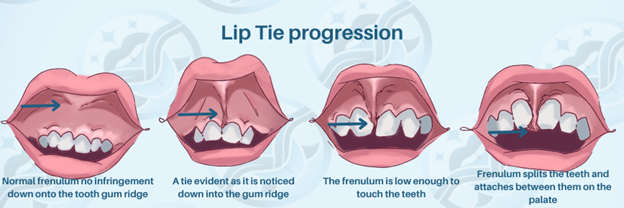
How a Lip Tie Creates Spacing
Think of the lip tie as a piece of elastic that’s too short. Every time you smile, eat, or move your upper lip, that band tugs on your gumline. The pull can cause two major problems:
- It prevents the front teeth from fully closing together.
- It can create a pocket between the teeth and gums, leading to gum recession or spacing relapse after braces.
Orthodontists often see this gap, but not all are trained to recognize the underlying cause. Many adults get braces, enjoy a beautifully straight smile, and then months or years later, notice that same front tooth gap creeping back.
That’s not poor orthodontic work; it’s untreated tethered oral tissue at play.
When Braces Don’t Stay Put: The Lip Tie Factor for Front Tooth Gap
You can move teeth into alignment, but if the soft tissue restriction remains, it will continue to pull and tug at the space it attaches to. Orthodontic relapse isn’t just about forgetting your retainer—it’s often about tension that your braces couldn’t fix.
When a lip tie is left untreated:
- The upper lip cannot rest comfortably against the teeth.
- The tissue continues to exert force on the gumline.
- The midline (center of your teeth) may drift.
- The front teeth can separate again, often leading to permanent retainers.
It’s a bit like tying your shoes and then constantly tugging on the laces—the knot eventually loosens, no matter how well you tied it. If your last resort was to have a permanent retainer placed, then please consider what forces are so great that this appliance is necessary to keep your teeth straight.
Lip Ties and Orthodontic Relapse: What Every Adult Should Know
Why Braces Alone Aren’t Enough
Orthodontics focuses on alignment, while oral myofunctional therapy and frenulum assessment focus on function.
A comprehensive adult care plan should address both. When the lip tie isn’t released and retrained through myofunctional therapy, the mouth can’t achieve true balance.
Here’s what often happens:
- Braces bring the teeth together.
- The lip tie remains and continues to tug.
- The teeth slowly move apart again.
That’s why many orthodontists now partner with speech-language pathologists and myofunctional therapists, experts who assess tongue, lip, and cheek mobility. These professionals understand how each muscle and connective tissue contributes to oral harmony.
Signs Your Lip Tie May Be Affecting More Than Your Smile
A front tooth gap might be your first clue, but lip ties can cause a range of subtle, long-standing issues in adults:
- Difficulty closing the lips at rest
- Gum discomfort or sensitivity above the front teeth
- Gingivitis
- Chronic tension in the upper lip or nose leading to headaches
- Speech sounds that feel “tight”/ nasal/ slushy
- Open mouth chewing
- Digestive discomfort
- Bad breath
- Snoring/sleep apnea
- TMJ pain
If these symptoms sound familiar, it’s worth exploring whether your lip tie could be the real reason you have a front tooth gap.
For a deeper dive into lip ties, please check out our other articles HERE to fully arm yourself with knowledge as you head into your orthodontic consult.
The Co-Occurrence of Lip Ties, Tongue Ties, and Cheek Ties
Why One Tie Rarely Stands Alone
The mouth functions as a connected system of muscles and fascia. If one area is restricted, others often compensate.
In adults, it’s incredibly common for a lip tie to exist alongside a tongue tie or cheek tie, a trio of tethered oral tissues that silently shape how your mouth moves, how your teeth rest, and even how you breathe.
A tongue that’s tethered can’t rest properly on the palate. This leads to:
- Mouth breathing instead of nasal breathing
- Low tongue posture
- Narrow palate development impacting airway health
- Shifting tooth positions and bite collapse
- Speech imprecision
- Chewing and swallowing difficulty
- Snoring/sleep apnea
- Digestive issues
- Headaches
- Anxiety
Meanwhile, cheek ties can pull on the corners of the mouth and gumline, creating lateral tension that influences how the teeth and jaw settle after braces.
Just as the lip tie influences teeth, so does a cheek tie. This tether is often overlooked for its impact and influence on the dental arches. Due to the cheek tie’s location, it also impacts facial tension and vision, as well as TMJ discomfort.
The result? A constant tug-of-war between orthodontic correction and muscular/fascia restriction.
The Domino Effect: When Oral Ties Affect the Whole Face
Untreated ties don’t just affect the teeth; they change facial dynamics over time.
A restricted tongue sits low, altering swallowing and posture. A tight lip tie pulls upward on the gumline. Cheek ties draw tension sideways. The forces combine to subtly distort dental alignment, jaw function, and even facial symmetry.
That’s why addressing a front tooth gap often requires more than cosmetic repair; it requires functional freedom through exercise and surgical release.
Before and After Braces: Why Assessment Matters with Front Tooth Gap

What to Ask Before Orthodontic Treatment
If you’re considering braces or aligners, make sure your orthodontic provider screens for tethered oral tissues.
Here are essential questions to ask:
- Do you assess for lip, tongue, and cheek ties before treatment?
- Will you refer me for myofunctional therapy if restrictions are found?
- How do you manage relapse prevention for patients with lip ties?
Without addressing the root cause, orthodontic success may be temporary. If your orthodontist shakes their head and brushes off your concerns of an oral tie, you may want to consider a second opinion.
There’s a reason you arrived in adulthood with your tethers fully intact. Medical professionals have a long-standing mantra that oral ties are a fad and that addressing them is unsupported by evidence and research.
Professionals typically make statements like this with little to no experience treating oral ties. Not all doctors and therapists are created equal. We like to think that they are, that any orthodontist looking at your teeth would certainly know to assess for oral ties. However, it is not a part of the orthodontic consultation.
Unless you seek out an airway-centric orthodontic practice, these medical professionals have additional training in the impact of oral ties. Your medical experts, if you will. It is worth your time and effort to locate an airway-centric/focused orthodontist to ensure that your adult orthodontic journey will end successfully.
We like the website Tongue Tie Life for its comprehensive list, organized by state, to help you narrow your search for a preferred provider.
Post-Orthodontic Relapse: What You Can Do
If your front tooth gap has returned, don’t panic, it’s fixable. The key is to identify the why.
- Have a Frenum Evaluation
A speech-language pathologist trained in orofacial myofunctional disorders can assess your lip, tongue, and cheek mobility. - Add Myofunctional Therapy
Retraining your oral muscles can stabilize your bite and prevent future movement. - Consider Frenectomy (Release)
In most cases, a surgical or laser frenectomy may be recommended to release the tether and restore natural movement. - Coordinate with Your Orthodontist
Once released and retrained, your teeth can be gently realigned and maintained—with long-lasting results.
The Functional Side of the Front Tooth Gap
Beyond Aesthetics: Breathing, Swallowing, and Posture
Your teeth aren’t independent from your airway or your posture.
When a lip tie keeps your lips apart, you’re more likely to breathe through your mouth. Chronic mouth breathing dries oral tissues, alters tongue position, and encourages narrow arch development, all of which impact the stability of your bite and your health.
A tongue tie compounds this issue by anchoring the tongue low, preventing it from resting on the palate where it should help maintain arch width. Cheek ties tighten the sides, narrowing the space even more.
The result? Your dental structure becomes the battlefield for your body’s compensation. Your jaw, neck, head, back, and pelvic floor are all shifting to accommodate the oral tethers. So if you’ve been dealing with recurring jaw pain or hip pain along with your front tooth gap, it may be time to consider the role of oral ties.
The Long-Term Impact on Oral Health
Ignoring a lip tie’s impact can contribute to:
- Gum recession (from constant tissue pull) that leads to gingivitis
- Tooth sensitivity or exposure of roots
- Misalignment that returns post-orthodontics
- Chronic jaw tension or TMD symptoms
Over the years, these mechanical stresses can cascade into issues with head, neck, and even pelvic alignment—because fascia (connective tissue) runs from the mouth to the rest of the body like a continuous web.
That’s why treating a front tooth gap caused by a lip tie isn’t about vanity—it’s about vitality.
Adult Lip Tie Treatment: What to Expect
Step 1: Comprehensive Evaluation
A myofunctional evaluation looks at:
- Lip mobility (how well your upper lip lifts and seals)
- Frenulum attachment (location, thickness, flexibility)
- Compensation patterns (cheek or chin strain during speech)
- Co-existing ties (tongue and buccal/cheeks regions)
The goal isn’t just to “see the tie,” but to understand how it functions within your unique anatomy, and if there is more than one oral tie present, the impact on functional tasks of speech, feeding, and breathing.
Referral to preferred surgical release providers to confirm the presence and degree of ties.
Step 2: Myofunctional Therapy
Before and after any frenectomy, therapy is essential.
It helps you retrain the tongue, lips, and cheeks to move correctly, preventing reattachment and ensuring proper oral rest posture.
Think of it as physical therapy for your mouth—it builds strength, coordination, and balance for speech, chewing, swallowing, and breathing tasks.
Understanding the benefits of myofunctional therapy and how it can enhance your overall health is crucial to preventing orthodontic relapse and addressing the front tooth gap. We’ve put together several articles on myofunctional treatment that you may find helpful.
Step 3: Frenectomy
If your tie significantly restricts movement, a release procedure can be performed using scissors, scalpel, or laser. The method depends on your anatomy and the provider’s preference.
Recovery is usually quick, but what matters most is pre- and post-release care—guided exercises that prevent scarring and reattachment.
Step 4: Ongoing Orthodontic and Functional Support
After treatment, orthodontic adjustments may help refine your alignment.
However, when done in coordination with a myofunctional therapist, results last longer because the mouth now works with your braces—not against them.
The Bigger Picture: Self-Advocacy and Awareness
For years, adults with front tooth gaps were told it was “just genetics” or “just cosmetic.”
But as we’ve learned more about tethered oral tissues, that narrative is changing.
It’s not about being stuck with it, it’s about physiology that can be changes for the better.
Your body has been compensating for decades. Once you identify and release those restrictions, healing can extend beyond your smile—improving breathing, sleep, posture, and even facial comfort and symmetry.
Common Myths About Lip Ties and Front Tooth Gaps
Myth #1: “Only babies have lip ties.”
Truth: Many ties are overlooked in infancy and childhood, with medical advice that the child will fall and break it on their own. Speech and feeding issues may be present and only become progressively more symptomatic in adulthood.
Myth #2: “If braces fixed the gap, it’s gone for good.”
Truth: Without addressing the tie, relapse is common, even with permanent retainers.
Myth #3: “A small tie can’t cause big problems.”
Truth: It’s not about size—it’s about function. Even a thin, high-attaching tie can cause significant tension.
Myth #4: “You just need to clip it.”
Truth: Release without therapy is like knee or shoulder surgery without physical therapy.
When to Seek Help for Front Tooth Gap
If you’re an adult noticing:
- A recurring front tooth gap
- Upper lip tension
- Difficulty closing lips at rest
- Persistent orthodontic relapse
- Speech or swallowing changes
…it’s time to explore whether a lip tie (and possibly a tongue or cheek tie) is part of your story.
Reclaiming Your Smile and Function from a Front Tooth Gap
At Lynn’s Tied Together Hub, we believe in untangling more than tissues. We help adults reconnect to their body’s natural balance through awareness, function, and freedom of movement.
Your smile isn’t just about aesthetics—it’s a reflection of how harmoniously your mouth and body work together.
So if your front tooth gap keeps making a comeback, don’t just close the space.
Find out why it’s reopening.
Because sometimes, the smallest tissue can hold back the biggest smile.
Key Takeaways Front Tooth Gap
- A front tooth gap can often be caused or worsened by a lip tie.
- Untreated lip ties can lead to orthodontic relapse, gum issues, and oral tension.
- Tongue ties and cheek ties frequently co-occur, influencing bite and alignment.
- Myofunctional therapy before and after release ensures lasting results.
- Comprehensive care means addressing both structure and function—for a smile that truly stays.
Ready to learn more?
Dive into the blog library and check out the other resources at Lynn’s Tied Together Hub