
If you have ever wondered, “What is a lip tie?” you are not alone. Many adults begin asking this question only after years of unexplained symptoms—thin or tight upper lips, difficulty closing the mouth comfortably, chronic dry lips, mouth breathing, or dental problems that seem to keep returning despite excellent care.
A lip tie is a tethered oral tissue restriction that can affect appearance, breathing, oral posture, and even overall body tension. While many people associate lip ties with infants and breastfeeding challenges, adults frequently live with the effects for decades without realizing that the small band of tissue connecting the upper lip to the gums may be causing problems.
At Lynn’s Tied Together Hub, we regularly hear from adults who say something like:
“I had no idea that tiny piece of tissue could cause so many problems.”
Or “It always bothered me, but I thought it was normal.”
Understanding what a lip tie is and how it affects the entire oral system is the first step toward identifying whether this restriction could be contributing to your symptoms.
What Is a Lip Tie?
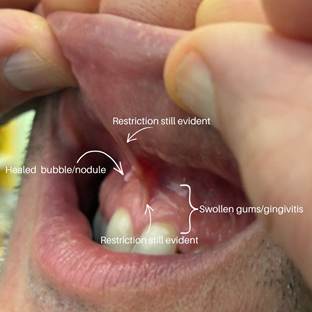
A lip tie occurs when the labial frenulum, the thin piece of connective tissue that attaches the upper lip to the gums, is unusually tight, thick, or restrictive. You can also have a lower lip tie, where the frenulum attaching the lower lip is too thick, tight, or restrictive.
You may also have both an upper and lower lip tie.
Everyone has a frenulum. It is a normal anatomical structure. The problem occurs when the tissue restricts normal lip movement.
The job of a frenulum is to support the muscle as it moves.
When a lip tie is present, the upper or lower lip cannot move freely away from the gums. Instead, it may feel tight or appear pulled inward toward the teeth.
In adults, this restriction can affect:
- Lip mobility
- Oral posture
- Breathing patterns
- Facial muscle tension
- Dental health
- Appearance
- Anxiety
In many cases, a lip tie is not an isolated issue. It often appears alongside other tethered oral tissues, including tongue and cheek ties. Check out my other articles on tongue, lip, and cheek ties for a comprehensive understanding HERE
Because the oral system functions as an integrated network of muscles and fascia, restrictions in one area often influence the rest. A lip tie on its own can certainly throw off the balance of the oral system.
This concept of an integrated network is based on the way fascia lines up and runs through the mouth and body. The lip frenula are directly linked to the fascia bands. These bands run to the jaw, voice, diaphragm, pelvic floor, and all the way down to your toes.
Hence, a hiccup at the lip can influence posture and balance!
The Anatomy Behind a Lip Tie
To understand what a lip tie is, it helps to look more closely at the anatomy involved. Let’s examine the upper lip.
The labial frenulum attaches the upper lip to the maxillary gum tissue. In a typical structure, this tissue allows the lip to move easily when smiling, puckering, speaking, eating, and swallowing.
However, when the frenulum is restrictive, it may:
- Attach lower on the gum line closer to the teeth
- Extend between the front teeth, forcing them to part
- Feel thick or fibrous existing with extra tissue rather than thin and flexible
- Limit lip range of movement
When this occurs, the lip can struggle to form correct postures. Rather than a smooth, rounded pucker, it will flange outward or lift/raise up toward the nose. When retracting for a smile or an S-sound production, it pulls into the gumline, seeking support from the maxillary arch.
Over time, the body often compensates for this restriction in range of motion. These compensations can include changes in facial muscle patterns, breathing habits, and swallowing mechanics.
Often placing undue stress on the jaw joint.
Many adults do not realize that the small frenulum has been influencing their oral function for years. In doing so, it triggered a cascade of compensatory responses throughout the body to support the oral system.
Signs and Symptoms of a Lip Tie in Adults
Adults with lip ties often describe symptoms that seem unrelated at first glance. Because lip ties affect oral posture and muscle balance, the effects can appear in several areas.
One of the most common concerns adults mention is the appearance of the upper lip.
Some people notice their upper lip appears:
- Thin
- Tight
- Difficult to lift
- Flat in the philtrum area
Others feel that their smile appears “toothy” or “gummy” because the lip does not drape naturally over the teeth.
Covering the mouth for photos and spending a ton of money on makeup to “bulk up” the lips can be exhausting.
The other impact is on facial symmetry. When lips are restricted, they don’t easily rest together. Leading to open-mouth postures. Open-mouth breathing and posture lead to elongation of the facial features and an overall tired look.
In addition to appearance changes, many adults experience functional symptoms.
Common lip tie symptoms include:
- Dry or chapped lips
- Difficulty comfortably closing the mouth
- Open-mouth chewing
- Air swallowing that contributes to reflux/digestion issues
- Lip tension while speaking
- Upper lip fatigue when smiling for photos/playing instruments
- Tension in chin
- Facial tension and fatigue
Many of these symptoms relate to compensatory muscle use. When the lip cannot move freely, other muscles attempt to assist.
Over time, these patterns may contribute to broader issues involving jaw tension, neck tightness, and posture issues.
Lip Ties and Mouth Breathing
One of the most important connections discussed at Lynn’s Tied Together Hub is the relationship between lip ties and mouth posture.
Healthy oral posture involves:
- Lips closed
- Tongue resting on the palate
- Teeth lightly touching or slightly apart
- Nasal breathing
When a lip tie restricts the upper lip, closing the lips comfortably may become difficult.
Some adults report that they habitually hold their mouth slightly open. Others notice that they chew with their mouth open because sealing the lips requires effort.
Over time, this pattern may contribute to mouth breathing.
Mouth breathing can lead to:
Dry mouth
Snoring
Poor sleep quality
Dental decay
Gum irritation
Because the lips play an important role in maintaining a closed oral posture, a restrictive lip tie can disrupt this natural balance.
The Fascial Connection: Why Lip Ties Affect More Than the Lip
A concept frequently explored in Lynn’s Tied Together Hub articles is the role of fascia.
Fascia is a connective tissue network that runs throughout the body. It links muscles, bones, and organs into a continuous web.
When a lip tie restricts movement in the upper lip, tension can travel through this fascial network.
This tension may influence:
Jaw mechanics
Neck posture
Facial muscle balance
Swallowing patterns
Many adults who explore lip ties also begin to notice connections between oral restrictions and symptoms such as jaw tightness or facial fatigue.
These relationships highlight why myofunctional therapy often plays a key role in treatment.
A foundational part of treatment is myofascial release for the face. Here we can address all the frenulas and relieve tension along the fascia pathways. Layer that with a stretching program, as we do with Debra Beckman stretches, and you’ve created passive exercises that prime the area for more challenging active exercise.
Lip Tie vs. Tongue Tie: What’s the Difference?
People often ask whether lip ties and tongue ties are the same thing.
While they both involve restrictive oral tissues, they affect different structures.
A tongue tie restricts the lingual (tongue) frenulum, which connects the tongue to the floor of the mouth.
A lip tie restricts the labial frenulum connecting the lips to the gums.
However, these restrictions frequently occur together.
When both restrictions exist, they may influence:
Swallowing patterns
Speech articulation
Breathing habits
Facial muscle balance
Several articles on Lynn’s Tied Together Hub Blog explore this relationship in greater depth, including discussions of why tongue-ties hurt, how restrictions pull on the fascial system, and why releasing one structure without addressing the others may not fully resolve symptoms.
Can Lip Ties Cause Dental Problems?
In some cases, lip ties influence dental alignment and gum health.
When the frenulum extends between the front teeth, it may contribute to a gap between the upper incisors, known as a diastema.
In the lower row of teeth, tension from the frenulum may also cause diastema or an overlap of the front two teeth.
A tight lip attachment may also place tension on the gum tissue. Over time, this tension can cause the gum to recede or lead to gingivitis.
Some adults notice:
Gum recession
Food trapping near the frenulum
Difficulty flossing the front teeth
Persistent irritation in the upper gum area
Dentists sometimes identify lip ties during orthodontic evaluations, especially when tooth movement becomes difficult due to tissue tension. Sadly, most dentists are not trained to identify tethers or their impact on the system.
That’s why it’s important to speak with preferred providers who understand the impact your lip tie may be having. So when you ask, “What is a Lip Tie?” to your next medical professional, make sure it’s one who will have the correct answers for you. I like the website Tongue Tie Life for its state-by-state list of preferred providers.
However, because lip ties affect both function and structure, evaluation by professionals familiar with myofunctional therapy can provide additional insight.
Myofunctional Therapy and Lip Ties
Before considering any surgical procedure, many adults benefit from learning about myofunctional therapy.
Myofunctional therapy focuses on retraining the muscles of the mouth and face.
This therapy helps individuals develop healthy patterns for:
Breathing
Swallowing
Lip posture
Tongue placement
In the context of lip ties, therapy often prepares the muscles for improved mobility.
Exercises may help:
Reduce compensatory muscle tension
Improve lip strength
Establish proper oral posture
Support healing after any surgical release
Because the mouth functions as a coordinated system, strengthening the surrounding muscles helps the body adapt to structural changes.
Many readers are unfamiliar with myofunctional therapy, so I put some articles together that take a deeper dive into explaining myofunctional therapy and myofascial release.
What Is a Lip Tie Without a Surgical Release?
In some cases, individuals choose to pursue a lip tie release, also known as a frenectomy.
This procedure removes or loosens the restrictive frenulum to allow greater lip mobility.
Everyone has a frenulum; it supports the lip muscles. Surgical release does not eliminate the frenulum; it simply frees it to move as intended.
Modern techniques often involve:
Laser procedures
Minimal bleeding
Short procedure times
However, the release itself represents only one step in the process.
Without proper preparation and rehabilitation, the tissue may heal tightly again, or the body may continue using the same compensatory patterns.
This is why many professionals emphasize the importance of:
Pre-release therapy/exercises
Post-release therapy/exercises
Guided recovery support
These steps help ensure that the mouth learns to use its newly available range of motion.
The surgical release takes place in an office setting, with the patient seated in a dental chair. The laser seals the tissue as it cuts, resulting in quick healing times and minimal bleeding. The procedure itself takes less than 5 minutes.
Recovery in days 1-3 may involve increased swelling and pain, but these are typically managed with over-the-counter medication. Typical activities are resumed immediately. By the end of week one, pain has reduced, and healing is well underway.
Functional improvements begin to be noticed by day two!
Why Many Adults Asking “What Is a Lip Tie?” Discover It Later in Life
Many adults express surprise when they first learn about lip ties.
Unlike other conditions that receive routine screening, lip ties often go unnoticed during childhood.
For those who were noticed, parents are usually advised to do nothing. Instead, they are told to go home and wait for the young child to fall and hit their face, thereby breaking the frenulum open. This breakage will free it from being tied.
Interesting medical advice, if we can even call it that!
Congratulations, you led a very safe childhood and never suffered a facial trauma, arriving safely into adulthood with your lip tie intact!
You’ve now spent your life compensating for this tiny little band of tension that was ignored in your childhood.
Symptoms may appear gradually as the body adapts to restrictions over time.
Adults may begin searching for answers after experiencing:
Chronic lip dryness
Jaw tension
Difficulty maintaining lip closure
Persistent dental concerns
Appearance changes in the upper lip
In many cases, discovering the concept of tethered oral tissues provides a new lens through which longstanding symptoms begin to make sense.
What Is a Lip Tie? Learning More About Tethered Oral Tissues
Understanding lip ties often opens the door to a broader conversation about tethered oral tissues and their impact on oral function.
At Lynn’s Tied Together Hub, we explore these topics through educational articles that connect anatomy, function, and real-world experiences.
Readers frequently continue their learning by exploring related resources:
- FREE Self-Check for Lip Tie
- Ebook/paperback: Untangling the Ties: A Guide to Adult Tongue Tie and Tethered Oral Tissues
- FREE WEBINAR: watch the replay – Tied Together: Understanding Adult Tongue, Lip, and Cheek Ties
Each resource helps build a clearer understanding of how the mouth works as an integrated system and why you should stop letting medical professionals lead you astray!
Ready to Go Deeper? Start With the Free Training
If you found yourself recognizing symptoms while reading this article, you may be wondering what your next step should be.
As someone who works with adults navigating tongue ties, lip ties, and other tethered oral tissues every day, I created a free educational webinar to help you understand what to look for and how to begin evaluating your own oral function.
In this training, you’ll learn:
How to identify signs of tethered oral tissues
Why symptoms often appear in adulthood
How myofunctional therapy supports recovery
What to expect if you are considering a release procedure
This webinar provides the foundational knowledge many people wish they had discovered years earlier.
Ready for More Personalized Guidance?
For those who want a deeper level of support, my signature Course walks you through the process of understanding your oral restrictions and preparing your body for optimal recovery, step by step.
As someone who has helped countless adults navigate this process, I know that learning about tethered oral tissues can feel overwhelming at first. But once you are dialed in, you realize action is needed.
That is exactly why I created a self-paced online course to guide you step by step.
As a therapist with 30-plus years of experience, I believe deeply in empowering people with knowledge. I designed this course so you can absolutely work through it independently in the comfort of your own home!.
What Is a Lip Tie? Your Next Step
If you have been asking yourself, “What is a lip tie?”, you have already taken an important first step.
Education is powerful. The more you understand how oral structures influence breathing, posture, and muscle balance, the easier it becomes to identify the root causes of persistent symptoms.
If you’re ready to continue learning, start with the free webinar to see whether tethered oral tissues may be affecting you.
And if you want structured guidance through the entire process—from identification to recovery, the Adult Focused Course will walk beside you every step of the way.
Because when you understand how your oral system truly works, you can begin restoring the function your mouth and body were designed to have.